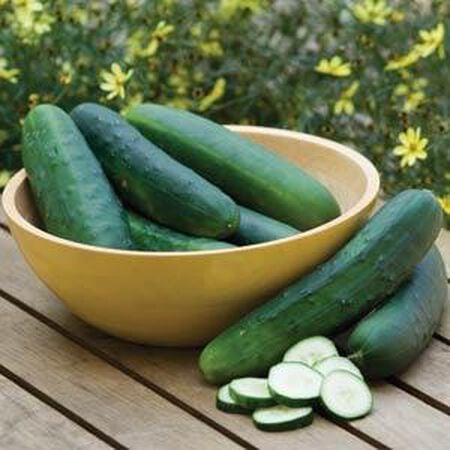
Burpee Hybrid II, (F1) Cucumber Seeds
Out of Stock
Key Attributes




Key Attributes
Product Details
Plant Height
8-12"Botanical Name
Cucumis sativusSeed Type
SeedAdditional Characteristics
Disease ResistantSeeds Per Gram
38Seeds Per Pound
17,200Row Spacing
6'Packet
25 SeedsSow Depth
1/2"Disease Resistance
CMV, DMSeeds Per Ounce
1,075Fruit Color
GreenBreed
F1 HybridSun
Full SunTypes
Burpless CucumberMaturity
Main SeasonGrowing Conditions
Greenhouse Production, Field ProductionLife Cycle
AnnualSow Method
Direct SowPlant Spacing
12-24"Categories
CucumberDays To Maturity (# Days)
55Seeds Per Acre
15 oz.Components
Growing Instructions
 Learning Download: How to Grow Cucumbers
Cucumbers can be grown for fresh eating, pickling and more. They range in flavor, colors, shapes and sizes. Cucumbers can grow in circles, elongated spheres and more.
Before Planting: Requires warm, well-drained soil high in fertility, with a pH of 7.0 for best results. Consistent moisture is needed to produce an high yields of good size cucumbers. Cucumbers do not tolerate cold so sow after any possibility of frost has passed. Make sure both soil and air temperatures have warmed prior to planting.
Planting: For direct seeding, wait until soil is warm, at least 70°F. Cucumber seeds will not germinate at a soil temperature below 50°F. Sow 2-3 seeds/ft., 1/2″ deep, in rows 6′ apart. Thin to 12″ apart. For transplanting, sow indoors in at 1-2 seeds per cell, 3-4 weeks before transplanting. Thin to 1 seedling per cell when true leaves form. Keep temperature above 70°F day and 60°F at night. Transplant 12″ apart in rows 5-6′ apart. Do not disturb roots when transplanting. Peat pots work best to reduce stunting and transplant shock.
Watering: Water 1 inch per week. Water consistently, because inconsistent watering can create misshapen cucumbers.
Fertilizer: When planting, mix compost with a little bit of organic fertilizer. During growth, use liquid fertilizer and apply directly to the soil near the stem. Granular fertilizer also can be used, but work it into the soil around the
plant. Feed with fertilizer regularly.
Days to Maturity: Once fruit bears, pick cucumbers often. They can double in size quickly. (See each variety for days to maturity)
Harvesting: Once fruit bearing begins, pick daily to ensure steady harvest
Tips: To maximize the amount of cucumbers and decrease leaves, use a trellis or tomato cage to grow the cucumbers.
AVG. Direct Seeding Rate: 30 seeds/15′, 100 seeds/50′, 250 seeds/125′, 500 seeds/250′, 1,000 seeds/500′, 15M/acre at 2 seeds/ft. in rows 6′ apart.
Shipping Schedule
Our Seed Promise
 "Agriculture and seeds" provide the basis upon which our lives depend. We must protect this foundation as a safe and genetically stable source for future generations. For the benefit of all farmers, gardeners and consumers who want an alternative, we pledge that we do not knowingly buy or sell genetically engineered seeds or plants.
The mechanical transfer of genetic material outside of natural reproductive methods and between genera, families or kingdoms, poses great biological risks as well as economic, political, and cultural threats. We feel that genetically engineered varieties have been insufficiently tested prior to public release. More research and testing is necessary to further assess the potential risks of genetically engineered seeds. Further, we wish to support agricultural progress that leads to healthier soils, to genetically diverse agricultural ecosystems, and ultimately to healthy people and communities.
To learn more about the "Safe Seed Pledge" please visit www.councilforresponsiblegenetics.org.